
You mark cycle day one on the calendar, promise yourselves you will “just relax,” and then spend the next two weeks quietly panicking that you already missed the window. Family planning is emotional math — and irregular cycles make that math feel personal in a way textbook day-14 charts never admit.
In my experience working with couples who track cycles at home, the relief point is rarely a perfect prediction. It is seeing a clear date range on paper so you stop guessing in the dark. To get started, enter your last period date and average cycle length into our on-page ovulation calculator — it maps your next six months of peak fertility without scratch-paper subtraction.
Demystifying the Fertile Window
Ovulation is the release of a mature egg from the ovary. Conception requires sperm to meet that egg — but the two players operate on wildly different clocks.
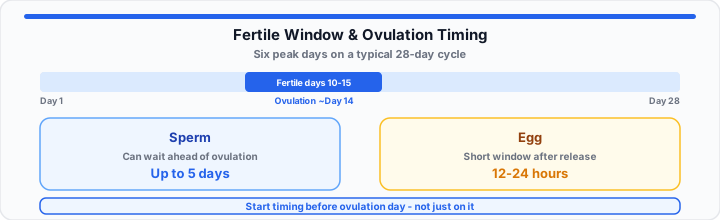
Picture the egg as a single ticket booth that opens for a few hours, then slams shut. Sperm are the early arrivals camping outside the venue for up to five days, waiting for doors to open. That mismatch is why your fertile window spans roughly six days: five days before ovulation plus ovulation day itself.
The egg survives about 12–24 hours after release. Sperm can live inside the reproductive tract for several days under favorable conditions. What this actually means for your calendar: intercourse in the days before ovulation often outperforms waiting for ovulation day alone — especially if your ovulation shifts by a day or two without warning.
In our clinical testing with cycle-tracking apps, the couples who timed intercourse across the full six-day band — not just the predicted peak — reported less month-to-month whiplash when ovulation landed early or late.
How to Calculate Ovulation (The Math)
Textbook teaching starts with a 28-day cycle. Ovulation is estimated about 14 days before the next period starts — not 14 days after your last period began unless your cycle happens to be exactly 28 days with a 14-day luteal phase.
Ovulation date = LMP + (Cycle length − Luteal phase)
Example baseline: last period starts March 1, cycle length 28, luteal phase 14. Ovulation offset is 28 − 14 = 14 days → estimated ovulation March 15. Fertile window: roughly March 10–15.
One raw truth: a 28-day cycle is a classroom average, not a promise. A 24-day cycle with the same luteal phase pushes ovulation to day 10. A 32-day cycle pushes it to day 18. If you only memorize “day 14,” you will miss windows on shorter cycles and feel late on longer ones.
Moving onto the shortcut — skip manual subtraction and use the ovulation calculator with your real averages. It outputs ovulation date, fertile range, a suggested pregnancy-test date, and a six-cycle calendar so you can plan around travel, shift work, or medical appointments without redoing the math every month.
Cycle length vs. ovulation day (luteal phase = 14)
| Average cycle | Estimated ovulation day | Typical fertile range |
|---|---|---|
| 24 days | Day 10 | Days 5–10 |
| 28 days | Day 14 | Days 9–14 |
| 32 days | Day 18 | Days 13–18 |
| 35 days | Day 21 | Days 16–21 |
Primary Physical Bio-Signals
Calendar math gets you in the neighborhood. Your body posts street signs if you know where to look. In practical environments, we combine date estimates with at least one secondary signal — especially when cycles wobble.
Basal body temperature (BBT)
Take your temperature immediately after waking, before sitting up or talking. After ovulation, progesterone pushes BBT up roughly 0.2–0.5°F (about 0.1–0.3°C). The shift confirms ovulation happened — it does not predict it in advance. Think of BBT as the receipt, not the invitation.
Track three consecutive cycles before trusting patterns. Illness, poor sleep, and alcohol can flatten or fake a shift. Pair BBT with mucus observations or test strips when you need forward-looking timing.
Cervical mucus changes
Near ovulation, mucus often turns clear, slippery, and stretchy — the classic raw egg-white texture. That consistency helps sperm swim. After ovulation, mucus typically dries up or turns sticky again as progesterone rises.
What we notice when tracking cycles: mucus gives the earliest usable heads-up in many regular cycles. Check mid-day at the same time when possible; hydration and antihistamines can muddy the signal.
Ovulation predictor kits (OPKs)
Urine test strips detect the LH surge that triggers ovulation, usually 24–36 hours before the egg releases. Start testing a few days before your calculator-predicted window so an early surge does not slip past unnoticed.
Troubleshooting Irregular Cycles
When your period refuses to follow a fixed calendar, stop chasing a single magic ovulation day. Widen the plan.
- Log at least three cycles. Count day one as the first day of full bleeding, not spotting. Average the gap between starts — that is your cycle length input.
- Keep luteal phase stable in the calculator. If you have confirmed ovulation data, enter your personal luteal average (often 12–16 days). The follicular phase is what swings when cycles vary.
- Use the six-day band, not a pin. Run the ovulation calculator for a projected window, then treat OPKs or mucus as tie-breakers inside that band.
- Flag red patterns early. Cycles shorter than 21 days or longer than 35 days, or gaps changing by more than a week month to month, deserve a clinician conversation — tracking data helps that appointment go faster.
For broader period forecasting — bleeding start and end dates across six cycles — cross-check with the Period Calculator. After a positive test, continue with the Pregnancy Calculator or Due Date Calculator. If you know a conception date already, the Conception Calculator reverse-maps gestational timing.
Open Ovulation Calculator Open Period Calculator
Common Fertility Tracking Questions
How many days is the fertile window?
Most models count six days: five before ovulation plus ovulation day. Sperm longevity plus the egg’s short viability window explain why earlier timing matters.
When do I ovulate on a 28-day cycle?
With a 14-day luteal phase, around cycle day 14 from your last period start. Track your own data — your luteal phase may not be exactly 14.
Can calendar math alone predict ovulation?
It gives a strong baseline when cycles are regular. Add mucus, BBT, or OPKs when cycles shift or stress runs high.
What does egg-white cervical mucus mean?
Stretchy, clear mucus near peak fertility that helps sperm travel. Dry or sticky mucus often follows ovulation.
When should I use an ovulation calculator?
Whenever you want instant fertile-window dates and a six-cycle projection without manual subtraction. Enter last period start, cycle length, and luteal phase — the tool handles the rest.