
There is a frustrating, familiar scene played out in kitchens every night: standing over a kitchen scale, staring blankly at a cold piece of chicken breast and a mound of brown rice, feeling completely exhausted by confusing nutritional labels. You work hard under the barbell, sleep eight hours, and eat clean, yet your reflection in the mirror looks virtually unchanged month after month. You know you need to feed muscle growth, but you are terrified of accidentally blowing out your waistline in the pursuit of hyper-specific size.
The confusion stems from treating nutrition like an arbitrary guessing game instead of an engineering process. Think of your daily macro split like building a high-performance brick wall on a construction site. Protein acts as the raw structural bricks themselves. Carbohydrates are the energetic construction workers running wheelbarrows back and forth across the site. Dietary fats function as the essential mortar and structural sealant keeping the entire layout weatherproof, solid, and stable. If you skip the bricks, the wall cannot rise; if you fire the workers, the bricks sit unused in the dirt; if you neglect the mortar, the first structural challenge collapses the entire system. Learning how to calculate macros for bodybuilding allows you to configure your building materials with absolute precision. When you build a personalized macro split calculator protocol around your actual baseline weight, you eliminate the guesswork and ensure every gram of food directly fuels clean hypertrophy. Map your targets instantly with our Macro Calculator.
The Fragmentation Trap: Why Blindly Copying Fixed Percentage Splits Fails
In my experience mapping out clean bulking phases for competitive lifters, the single fastest way to stall your progress is grabbing a generic “40/40/20” ratio from a one-size-fits-all template. These fixed percentage splits assume every human body processes energy identically regardless of total mass, training volume, or current body fat percentage.
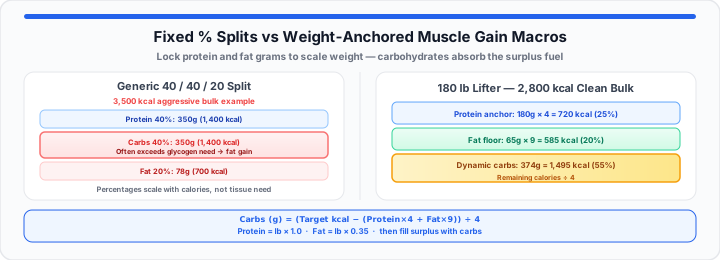
When I’m profiling athlete calorie scales, I routinely watch 170-pound lifters attempt to follow a flat 40% carbohydrate ratio on a 3,500-calorie aggressive bulk. That calculation forces them to chew through 350 grams of carbs daily—often far exceeding their actual glycogen storage capacity. The surplus energy gets stored as visceral fat, leading to smooth skin and water retention rather than dry muscle density. Percentages shift automatically based on your total caloric intake, but human biological requirements for tissue repair do not. Your liver, nervous system, and skeletal muscle tissue require hard gram targets tied to your scale weight, not relative pie-chart fractions. Establish your energy baseline first with the TDEE Calculator, then add surplus calories using the Calorie Calculator.
Optimal Hypertrophy Equation: Fixed Structural Anchors (Protein + Fats) + Dynamic Fuel (Carbs)
Step-by-Step: The Weight-Based Method for Manual Macro Allocation
To establish an ironclad nutritional protocol for clean weight gain, stop guessing percentages and use the weight-anchored step method. Here is how to construct your daily macro split manually:
- Establish Your Caloric Baseline & Surplus Target: Calculate your Total Daily Energy Expenditure (TDEE) based on your training activity level, then add a conservative surplus of 250 to 500 calories to create an environment for lean muscle accretion without excessive fat gain.
- Anchor Your Protein Ceiling First: Set your daily protein intake at exactly 1.0 gram per pound of total scale weight (or lean mass). This provides more than enough amino acids to maximize muscle protein synthesis without overwhelming digestion. Cross-check grams with the Protein Calculator.
- Establish Your Fixed Fat Floor: Set dietary fats at 0.35 grams per pound of scale weight. This keeps your testosterone levels and endocrine health protected without hogging energy calories that should belong to high-intensity training fuel. Verify targets with the Fat Intake Calculator.
- Solve for the Dynamic Carbohydrate Balance: Convert your allocated protein and fat grams into their equivalent caloric values, subtract them from your targeted total surplus calories, and divide the remaining caloric budget by 4 to find your daily carbohydrate gram target. Use the Carbohydrate Calculator to sanity-check the result.
Expressed cleanly in practical mathematical terms, your calculation formulas run as follows:
Daily Protein Grams = Scale Weight in Pounds × 1.0
Daily Fat Grams = Scale Weight in Pounds × 0.35
Daily Carbohydrate Grams = (Target Total Calories − ((Protein Grams × 4) + (Fat Grams × 9))) ÷ 4
Note: Dietary fat provides more than double the energy density per gram compared to protein or carbs.
Instead of manually tracking massive multi-column equations on a scratchpad or running the risk of simple math slips while planning your weekly meal prep under a tight schedule, you can drop your current scale weight directly into our interactive Macro Calculator to map out your muscle-building targets instantly.
Build Your Split in One Pass: Enter weight, activity, and surplus goals in the Macro Calculator —protein, fat, and carb grams update together from the same TDEE baseline as the TDEE Calculator.
Isolating Lean Mass vs. Total Scale Weight
In practical environments, calculation errors happen most frequently when an athlete carries a higher starting body fat percentage. If you weigh 220 pounds at 25% body fat, calculating your protein at 1.0 gram per total pound yields 220 grams of protein daily. That amount is unnecessarily high and taxes both your appetite and your grocery budget.
When I’m adjusting meal plans for clients carrying over 18% body fat, we calculate macros strictly against estimated Lean Body Mass (LBM) rather than gross scale weight. A 220-pound lifter at 25% body fat carries roughly 165 pounds of lean tissue. Anchoring protein to 165–180 grams frees up a massive amount of daily caloric room, which can be allocated to nutrient-dense carbohydrates that drive hard training in the gym. Estimate body fat with the Body Fat Calculator and derive lean mass using the Lean Body Mass Calculator. For measurement technique, see our body fat percentage beginner’s guide.
The Quick Reference Performance Sheet: Target Muscle Gain Ratios
To help you choose the right macro split for your specific physique archetype, review the reference matrix below. These profiles outline baseline targets for a 180-pound lifter aiming to build lean mass:
| Lifter Profile & Strategy | Daily Caloric Target | Protein Target | Fat Target | Carbohydrate Target | Estimated Split Ratio |
|---|---|---|---|---|---|
| Lean Hypertrophy (Slow, Clean Bulk) | 2,800 kcal | 180g (720 kcal) | 65g (585 kcal) | 374g (1,495 kcal) | 25% P / 20% F / 55% C |
| Hardgainer Ectomorph (High Metabolism) | 3,300 kcal | 180g (720 kcal) | 75g (675 kcal) | 494g (1,975 kcal) | 22% P / 20% F / 58% C |
| Body Recomposition (Maintenance Gain) | 2,400 kcal | 195g (780 kcal) | 60g (540 kcal) | 270g (1,080 kcal) | 32% P / 22% F / 46% C |
Real-World Adjustments: Tuning Your Metrics Based on Weekly Progression
In our client macro testing, no static calculation survives more than three weeks without needing fine-tuning. Your metabolism is a dynamic, living organism that adapts to increased workloads and changing body mass.
To keep muscle gain steady while minimizing fat accumulation, track your morning body weight on a three-day rolling average alongside weekly waist measurements taken directly at the navel. If your average scale weight increases by 0.5 to 1.0 pound per week while your waist measurement stays stable, leave your macro allocations completely untouched.
Moving onto plateau protocols: if your scale weight remains dead flat for two consecutive weeks, increase your daily carbohydrate target by 25 to 30 grams (adding roughly 100 to 120 calories to your daily intake) while leaving your protein and fat floors locked in place. Conversely, if your waist measurement expands faster than your scale weight, trim 30 grams of carbohydrates from your non-training days while keeping post-workout carbs high. This targeted adjustment protects your workout intensity while checking unwanted fat accumulation. If you are cutting instead of bulking, mirror the deficit workflow in our calorie calculator weight loss guide.
Open Macro Calculator Open TDEE Calculator
Frequently Asked Questions
What is the best macro ratio for a clean bodybuilding bulk phase?
For most natural lifters, an optimal clean bulking ratio is approximately 25% protein, 20% fat, and 55% carbohydrates. However, rather than strictly sticking to fixed percentages, it is far more effective to set your protein at 1.0g per pound of body weight, set fat at 0.35g per pound, and fill the rest of your daily surplus calories with carbohydrates.
How do you accurately adjust your daily macro split if your muscle gains hit a sudden plateau?
When scale weight stalls for more than two consecutive weeks, keep your protein and fat targets fixed and increase your daily carbohydrate intake by 25 to 30 grams per day (approximately 100 to 120 extra calories). Monitor your average weight over the next 14 days before making any further adjustments.
Why is it more effective to calculate macros based on body weight rather than raw percentages?
Calculating macros based on body weight ensures your biological baseline requirements for protein and essential fats are met regardless of your total calorie target. Fixed percentages can lead to excessively high protein targets during high-calorie bulks or dangerously low fat levels during low-calorie phases. Body weight anchors provide precise gram targets tailored to your actual physiology.