
If you are trying to use a finals grade calculator or final exams calculator but the math feels different in high school vs. college, you are not imagining it. Grading systems really do work differently—especially around finals weighting and point totals. For any syllabus that uses weighted categories and a big final, RapidRatio’s Finals Grade Calculator matches the same formulas covered below.
This guide breaks those differences down in plain language so you can adapt your own calculations, whether you are in high school quarters or a college class that is mostly exams.
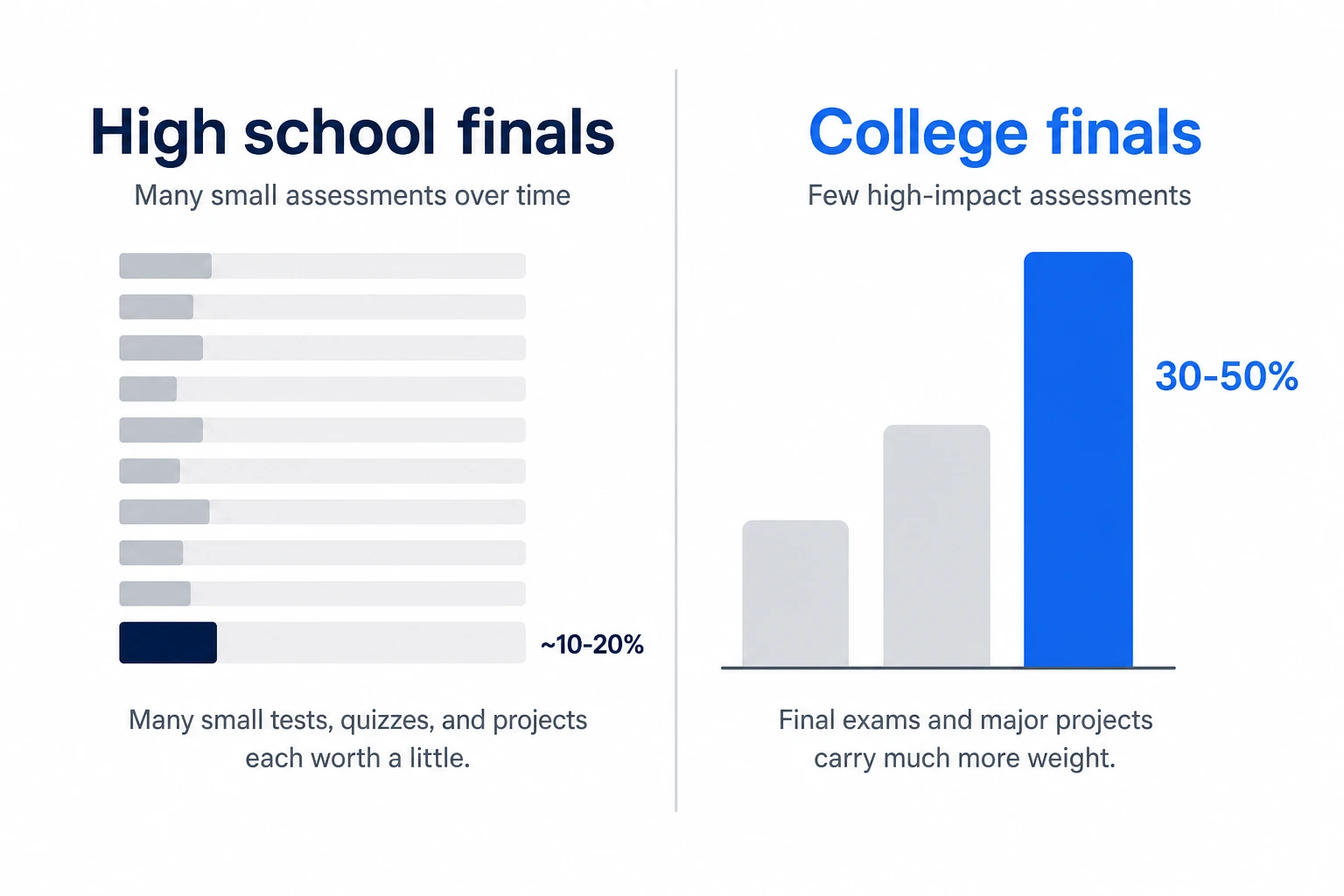
Why finals feel so different after high school
In high school, your grade often comes from lots of smaller items: homework, classwork, quizzes, projects, plus a few tests. Many schools convert class percentages into an unweighted 4.0 GPA scale (A = 4.0, B = 3.0, and so on).
College grading tends to be results-heavy: fewer graded items, more weight on midterms and finals, and a letter grade that becomes grade points multiplied by credits for your GPA. UCLA International grading overview
So when a college syllabus says “Midterm 30%, Final 40%,” the final carries much more power than the average high school test.
How college professors build your grade: points vs. weighted categories
College instructors usually pick one of two approaches:
- A total points system
- A weighted category system
They are mathematically equivalent if set up correctly—but they feel different from the student side.
Total points systems: everything is “out of X”
Every assignment and exam is worth a fixed number of points. Your course percentage is:
Course % = (Total points earned ÷ Total points possible) × 100
Example: 50 points of homework and 100 points of tests. If you earn 50/50 on homework and 75/100 on the test, that is 125/150, or about 83%. r/Professors discussion
When a test is worth twice as many points as all homework combined, it dominates without anyone writing “tests 67%” on the syllabus. For a notebook-style walkthrough, see How to Calculate Total Points System Grades (The Notebook Method).
Weighted categories: percentages on the syllabus
Other instructors specify weights clearly—for example:
- Homework: 20%
- Quizzes: 10%
- Midterm: 30%
- Final exam: 40%
Then:
Course % = (H × 0.20) + (Q × 0.10) + (M × 0.30) + (F × 0.40)
where H, Q, M, F are your category percentages. Under the hood this matches a points system if point values were chosen consistently. r/Professors
Takeaway: In college, whether the syllabus shows points or weights, exams are often a large share of the total—so a finals calculator has to treat them as big chunks, not just one more quiz. For the full weighted breakdown, read The Ultimate Guide to Calculating Your Final Grade.
The impact of graded midterms vs. a single final exam
High school classes often spread risk across many grades. College courses may compress it into a few.
Typical high school pattern
- Weekly homework or classwork, graded regularly.
- Several quizzes and unit tests.
- A final that counts like one or two tests, or 10–20% of the term grade.
With many gradebook rows, one bad final hurts but may not erase months of solid work—especially in unweighted classes with lots of items averaged together.
Typical college pattern
A course might look like:
- Midterm 1: 25%, Midterm 2: 25%, Final: 40%, Participation: 10%
Or:
- Midterm: 30%, Final exam: 50%, Homework/participation: 20%
Each exam is a huge slice. That is why college-focused finals tools ask for current grade, target, and final weight—they reflect how oversized one test can be.
How high school grading usually works (unweighted classes)
High schools mix unweighted and weighted setups, but day-to-day class grades often look like “traditional percentage with lots of small items” more than a college-style exam-heavy design.
Unweighted class grades
In a typical unweighted high school class:
- Each assignment is a percentage; the course average may be a simple mean or a light category split.
- The final may count as one more test or a small percent of the term (often 10–15%).
Letter grades then map to a 4.0 scale (for example 90–100% = A = 4.0).
Weighted high school GPA vs. unweighted classes
Schools often weight GPA for honors/AP, not every assignment inside a course. OpenEduCat high school gradebook context.
Unweighted GPA uses standard 4.0 mapping; weighted GPA adds bump points for advanced courses. The in-course percentage math can stay simple while the transcript layer applies weights.
How to adapt your calculations for unweighted high school classes
If your class does not use heavy category weights, you can often treat the final more like “one more big test” than a separate massive block. Our manual weighted-grade notebook walkthrough still helps when your teacher does assign explicit final percentages.
Case 1: Final counts as another test
If the final is just another 100-point test like the others, sum earned points and possible points across all tests including the final, then divide. That is a total-points slice inside the test bucket—same logic as our total points notebook guide.
Case 2: Final has a specific small weight (10–20%)
Use the weighted projection pattern:
Course % = Current × (1 − w) + Final × w
Example: current 88%, w = 0.10 for the final, you score 80% on the final → 88 × 0.90 + 80 × 0.10 = 87.2%. That is the same engine as a finals calculator—just with a smaller w than many college finals.
How college finals change your calculations
The algebra does not change; the weights do. High school finals might be 10–20% or “another test.” College finals are often 30–50% of the course.
- A small change in your final score can move a letter.
- Be precise about current grade and final weight—guessing can mislead you by a full letter.
Those course percentages then feed GPA through credits and grade points. When instructors curve, remember the tool shows raw numbers unless you add the curve yourself (see FAQ).
Putting it all together for your own finals calculator
Core steps for any finals grade workflow:
- Identify the system — high school “lots of scores” vs. college “few big exams.”
- Get your current grade — from the LMS or earned ÷ possible points.
- Confirm how the final counts — explicit percent of the course vs. another row in a points pool.
- Use the right formula — weighted projection: Current × (1 − w) + Final × w, or pure point totals when that matches the syllabus.
Once that mental model clicks, you can switch between scratch work, a finals calculator, and a richer planner without surprise.
FAQ
- How do final exams differ between high school and college?
- High school finals are often a smaller slice of a gradebook full of daily work; college finals are frequently 30–50% or more of the course and sit beside fewer total graded items.
- Can you use a finals grade calculator for a curved college class?
- Yes for your raw weighted math. A published curve moves reported grades above raw percentages—treat the calculator output as pre-curve unless you know the curve rule.
- How do you calculate your grade in an unweighted high school class?
- Add all earned points, divide by all possible points for the scope you are measuring (whole course or category), and turn that into a percentage—or use the right weighted slice if your teacher publishes weights.
References
- Varsity Tutors: Differences between high school and college grading
- College Raptor: Weighted vs. unweighted GPA
- MyEvaluationPal: GPA scale explained
- LAEP GPA conversion chart (PDF)