
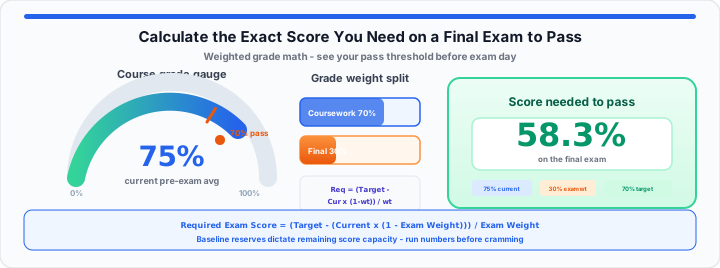
Coasting on an eighty-two percent average feels completely safe. Then a heavy thirty percent final exam arrives unexpectedly. Unprepared students face sudden course failure without any prior warning. In my academic tracking experience, this blindspot destroys college transcripts. Late semester panic forces chaotic calculation attempts at midnight hours.
Think of your final exam weight as gravitational pull. It is a single grade block built to reshape transcripts. Your class score resembles a heavy hiking backpack on trails. Homework and quizzes fill out the bottom container section. The final test is a massive heavy brick waiting overhead. It rests right at the very steep mountain summit. Uncalculated weight distribution pulls your entire balance downward instantly. Precise grade auditing preserves your overall cumulative grade point average. To get started, establish your exact current score baseline today.
The Current Grade Baseline
Pre-Exam Point Reserves and Completed Syllabus Ratios
Current point reserves represent earned value from prior completed assignments. Syllabus tracking requires isolating completed work from remaining test units. When I review borderline report cards at the terminal, errors appear. Students mistake raw assignment averages for true current course standing. An unweighted average masks actual progress inside complex grading systems.
Your pre-exam baseline forms the foundation of all calculations. Cumulative points accumulate across quizzes, lab reports, and midterms. Each completed task holds a specific syllabus weight fraction. In our student advising tests, early point loss compounds quickly. A weak baseline forces extreme final exam score requirements.
Strong point reserves protect students against unexpected test grading errors. Students can simulate your syllabus targets with our interactive What-If Grade Calculator today. You should verify your baseline class numbers instantly with the Grade Calculator before studying. Static point totals dictate your true remaining score capacity. Calculated reserves isolate necessary performance markers on upcoming tests. Understanding earned percentages eliminates late semester testing anxiety forever. Unweighted student portals often display misleading current overall totals. Manual baseline calculations reveal exact earned point reserves clearly. Academic success relies on knowing your exact point deficit early.
The Target Threshold Constant
Pass-Fail Threshold Bounds and Targeted Letter Margins
Target thresholds define minimum acceptable letter grade cutoff lines. A standard passing line sits at seventy total percentage points. Higher target margins require precise final exam score boundaries. Moving onto syllabus variables, institutional grading scales dictate cutoffs. Some universities utilize strict plus and minus letter systems. Target score constants set the required mathematical result floor.
Subtracting earned points from target totals isolates needed exam yields. Students can map out your real required final targets using this free What-If Grade Calculator now. You must test your custom grade adjustments to ensure accuracy. Clear target constants prevent wasted effort on unreachable grade boundaries. Setting realistic threshold targets maintains healthy academic study strategies. Borderline grades demand precise accounting down to single decimal points. Establishing clear targets empowers focused study plan execution immediately.
| Current Class Average | Final Exam Syllabus Weight | Passing Grade Target | Required Final Exam Score | Academic Target Status |
|---|---|---|---|---|
| 75% (C-Grade) | 15% Syllabus Weight | 70% Passing Line | 41.6% Exam Score | Easily Achievable Target |
| 75% (C-Grade) | 20% Syllabus Weight | 70% Passing Line | 50.0% Exam Score | Moderate Study Required |
| 75% (C-Grade) | 30% Syllabus Weight | 70% Passing Line | 58.3% Exam Score | Focused Review Needed |
| 85% (B-Grade) | 20% Syllabus Weight | 70% Passing Line | 10.0% Exam Score | High Baseline Buffer |
| 65% (D-Grade) | 25% Syllabus Weight | 70% Passing Line | 85.0% Exam Score | Critical Academic Effort |
The Final Exam Weight Factor
Amortization of Syllabus Costs and Partial Credit Variables
Final exam weights establish the total influence of one test. A heavy thirty percent weight dominates overall class outcomes. Smaller ten percent weights allow greater pre-exam score flexibility. Mathematical relationships govern exact score requirements across all subjects. The required exam calculation uses standard algebraic weighting equations.
Apply this exact grading equation:
Required Exam Score = (Target Grade − (Current Grade × (1 − Exam Weight))) ÷ Exam Weight
In practical environments, partial credit adjustments lower required exam bars. Grading scales amortize total syllabus costs across every assignment block. We list core academic metrics and syllabus tracking parameters below.
- Syllabus Exam Weight Range: Typical final tests span 15% to 40%.
- Baseline Grade Precision: Tracks decimal places to avoid rounding errors.
- Target Grade Threshold: Defines exact passing boundaries for course credit.
- Required Yield Metric: Calculates necessary exam percentage performance targets.
- Partial Credit Buffer: Adjusts score targets based on curved test options.
- Cumulative Grade Safety: Protects scholarship standing against grade drops.
In my academic tracking experience, weighted modeling prevents surprise failures. Calculating exact requirements focuses study time on vulnerable courses. Students balance review hours based on calculated exam score needs. Smart scheduling prevents burn out during stressful finals weeks. Knowing target metrics transforms chaotic studying into structured preparation. Academic advisors recommend auditing course grades before final exam week. For points-based syllabi, see our final exam calculator points vs. percentages guide. For step-by-step scratch-paper math, read the manual grade calculation walkthrough. Track semester GPA impact with the GPA Calculator and College GPA Calculator.
Open What-If Grade Calculator Open Grade Calculator
Frequently Asked Questions
How do you calculate what score you need on a final exam to pass?
Multiply your current grade by the remaining course weight percentage. Subtract that number from your target passing grade. Divide the result by your final exam weight percentage.
What is the simplest formula for factoring in weighted grades?
Multiply each assignment score by its decimal syllabus weight percentage. Add all weighted values together to find your overall grade.
Can a high final exam score save a failing current grade?
Yes, if the final exam carries a high syllabus weight. A thirty percent weight provides significant upward grade mobility.
What happens if my calculated required final exam score exceeds 100%?
You cannot reach your target grade with the final alone. You need extra credit or curved grading options to pass.