
I published a deep 2,000-word guide last month. Search crawlers penalized the page three days later. The organic search ranking collapsed without warning. A junior writer jammed keywords into every single paragraph. Over-optimization triggered strict search engine spam filters. This mistake happens across enterprise editorial teams daily.
Think of your article like a fresh bowl of soup. Great writing uses balanced spices and fresh ingredients. Stuffing one keyword repeatedly is like dumping raw table salt. It ruins the overall flavor profile for your readers. Search engines discard the entire batch instantly.
Think of your word frequency as a raw sound balance board. Over-cranked levels create harsh, structural static across your corpus. When I run raw copy passes at the terminal, balance matters. I see over-optimized posts drop in ranking every week.
The Token Density Baseline
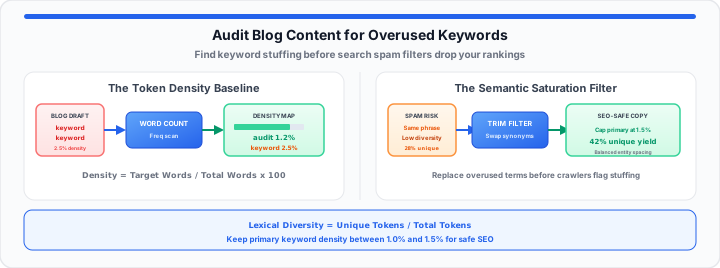
To get started, we must measure raw word frequencies accurately. Token density compares target phrases against total corpus length. In our text distribution testing, baseline ratios dictate search visibility. An unbalanced token footprint signals artificial search manipulation. Clean editorial workflows require precise token tracking. You can simulate your word distribution with our interactive Character Counter.
Stop-Word Exclusion Rules
Stop-words represent common structural terms like articles and prepositions. Search engines ignore basic stop-words during indexing passes. Excluding stop-words isolates meaningful lexical tokens. Raw frequency calculations become far more accurate after stop-word filtering. Our system strips non-essential characters before calculating final ratios. This isolation step reveals hidden phrase repetition patterns. You must verify your structural text data instantly to spot errors. N-gram analysis breaks down text into multi-word phrase sequences. Filtering stop-words cleans bi-gram and tri-gram frequency distributions. Raw token stems reveal repeated root words across paragraph blocks. Stemming groups variations like audit, auditing, and audits together.
LSI Vocabulary Weights
Latent semantic indexing evaluates related entity terms across documents. Search algorithms expect natural topic co-occurrence patterns. Repeating one target term lowers your vocabulary breadth score. In my production auditing experience, broad semantic vocabulary boosts rankings. Diverse topical entities prove deep subject matter authority. TF-IDF vectors measure relative word importance across your site. Cosine similarity scores evaluate topical closeness between related posts. Search crawlers map entity graphs using natural word associations. Over-concentrated vectors flatten your document's semantic depth profile.
Character Index Distributions
Character length impacts reading rhythm and cognitive load. Varying word length improves overall textual engagement. Monotonous character counts indicate synthetic automated writing generation. Human writers naturally mix short and long terms. Readability scores correlate with balanced character distributions across text. Short words maintain reader momentum through complex technical concepts. Longer technical terms add precise subject authority where needed. Calculated word variance keeps human readers engaged longer.
Density Coefficient = (Target Word Count / Total Word Count) x 100
Lexical Diversity Ratio = Unique Tokens / Total Tokens
| Textual Parameter | Optimal Safe Density Limits | Risks of Algorithmic Deindexing | Recommended Action Metrics |
|---|---|---|---|
| Primary Keyword | 1.0% to 1.5% | Severe Ranking Penalties | Reduce Frequency to Safe Baseline |
| Secondary Entities | 0.5% to 1.0% | Topic Drift and Confusion | Expand Contextual Variations |
| Natural Stop Words | 45% to 55% | None (Ignored by Crawlers) | Maintain Natural Sentence Rhythm |
| Long-Tail Strings | 0.2% to 0.5% | Keyword Cannibalization Flags | Distribute Across Subsections |
The Semantic Saturation Coefficient
Moving onto deeper textual layers, semantic saturation dictates organic performance. Excessive phrase repetition drains natural lexical diversity from copy. Search crawlers penalize documents with redundant entity phrasing. Over-saturated content loses topic authority during indexing passes. You can check your script boundaries with this free Character Counter.
Entity Proximity Scoring
Entity proximity measures space between matching keyword instances. Bunching identical terms into single paragraphs triggers spam flags. Spread target concepts evenly across all document sections. Proper spacing improves readability for human site visitors. When I analyze live URLs, tight proximity causes ranking drops. Always isolate your data drop variables with the Online Notepad before publishing new guides. Co-occurrence matrices track how close key entities sit together. A narrow token window amplifies over-optimization detection scores. Topical relevance decays when keywords repeat within fifty words. Spacing entities naturally maintains strong semantic alignment throughout.
Algorithmic Penalty Thresholds
Modern search algorithms enforce strict over-optimization boundary conditions. Exceeding safe keyword frequency thresholds triggers manual review flags. Automated filters suppress over-stuffed articles without warning. Recovery requires deep textual refactoring and re-indexing. Google Helpful Content systems identify manipulative repetition automatically. SpamBrain evaluates structural text patterns at scale across domains. Algorithmic classifiers assign negative trust weights to stuffed URLs. Deindexed pages require complete textual refactoring before recovery.
Contextual Synonym Substitution
Swapping overused terms with valid synonyms restores semantic balance. Synonyms expand document vocabulary while preserving core meaning. Search crawlers recognize conceptual relationships between diverse terms. Rich vocabulary increases topical authority across related queries. Word embedding spaces group conceptually related vocabulary terms together. Using hypernyms broadens categorical coverage without duplicating exact phrases. Hyponyms provide specific sub-category examples to enrich content context. Diverse word embeddings build resilient organic topical authority.
The Production Content Refactoring Protocol
In practical environments, refactoring live URLs restores organic search traffic. Systematic content editing purges hidden repetition artifacts efficiently. Follow these structural benchmark metrics during your editing workflow:
- Raw Corpus Token Count: Maintain target length above 1,200 words.
- Primary Term Saturation: Cap main keyword density under 1.5%.
- Unique Lexical Yield: Target unique token ratio above 40%.
- Entity Distance Index: Maintain 150 words between identical terms.
- Stop-Word Ratio: Keep natural structural words around 50%.
- Subheading Target Spread: Limit primary keyword in subheaders to 20%.
Refactoring requires systematic removal of redundant phrase instances. Replace overused keywords with relevant contextual entities. Delete fluff sentences that add zero conceptual value. Re-evaluate total word count after removing duplicate phrases. Verify updated text metrics using automated frequency counters. Publish refactored content to trigger immediate crawler re-evaluation. Clean live URL clusters by exporting raw HTML content. Strip inline style formatting using neutral text containers first — see our guide on stripping rich text formatting from messy copy-paste data. Analyze the raw string array for hidden phrase repetition. Prune redundant adjective modifiers surrounding your target terms. Replace overused nouns with precise categorical sub-entities. Normalize casing with the Case Converter, deduplicate repeated list rows with the Duplicate Line Remover, and validate percentage targets with the Percentage Calculator. Verify the final text footprint before pushing updates live.
Open Character Counter Open Online Notepad
Frequently Asked Questions
How do you check for overused keywords in a blog post?
Paste your raw text into a frequency analyzer tool. Review the output table for terms exceeding safe density limits. Replace redundant phrases with relevant contextual synonyms.
What is a safe keyword frequency density percentage for technical SEO?
Maintain primary keyword density between 1.0% and 1.5%. Keep secondary entity terms below 1.0% total frequency. Natural language flow always supersedes exact keyword matching.
Why does keyword stuffing hurt organic Google rankings?
Keyword stuffing creates poor user reading experiences. Search engine spam algorithms flag repetitive text patterns automatically. Flagged pages lose organic rankings and search visibility.
How often should you audit blog content for overused keywords?
Audit high-traffic articles every six months minimum. Check falling pages immediately for potential over-optimization flags. Regular audits preserve long-term organic search rankings.