
Pregnancy Conception Calculator
Conception Estimator
Results
| Most Probable Conception Dates | — |
|---|---|
| Most Probable Dates of Sexual Intercourse | — |
| Possible Conception Dates | — |
| Possible Dates of Sexual Intercourse | — |
How to Use This Pregnancy Conception Calculator
- Enter Your Due Date. Use the value that matches your current records or measurements.
- Enter Average Length of Your Cycles. Use the value that matches your current records or measurements.
- Press Calculate. Review the results table and any step-by-step breakdown the tool prints.
Pregnancy Conception Calculator Formulas and Practical Applications
Conception occurs when a sperm fertilizes an egg. This typically takes place within 24 hours of ovulation. Since sperm can live inside the female reproductive tract for up to 5 days, intercourse that occurs up to 5 days before ovulation can result in pregnancy.
Estimating Conception Dates
There are three common ways to estimate the conception date:
- Last Menstrual Period (LMP): If you have a regular 28-day cycle, conception typically occurs 14 days after the first day of your last period. For other cycle lengths, ovulation and conception happen approximately 14 days before the next expected period. Formula: Conception = LMP + (Cycle Length - 14) days.
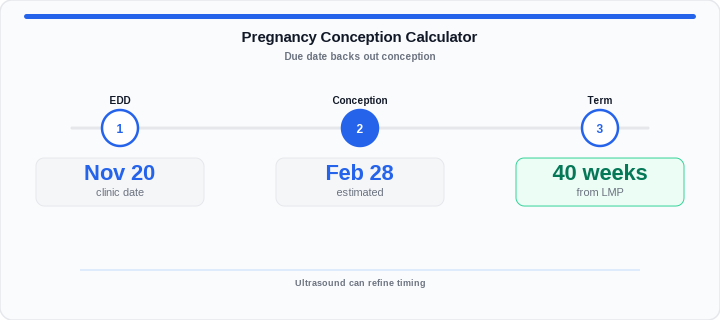
- Due Date: A standard pregnancy lasts 266 days (38 weeks) from conception. If your due date is known, the conception date is estimated by subtracting 266 days. Formula: Conception = Due Date - 266 days.
- Ultrasound Scan: If an early ultrasound estimates the baby's gestational age (which includes the standard 2 weeks before conception), the conception date is: Conception = Scan Date - Gestational Age + 14 days.
Frequently Asked Questions
What does this pregnancy conception calculator measure?
It applies the formulas and lookup tables described on this page to your inputs and prints the same fields you see in the results table—use it as a quick check before you copy figures into email or client paperwork.
Are the results medical or legal advice?
No. Outputs are estimates for planning and education. Confirm high-stakes decisions with qualified professionals and your local standards.
Why might my hand calculation differ slightly?
Rounding order, unit conversions, and intermediate precision change the last digit. Match the tool’s units and rounding rules when you compare on paper.
Does this page store my data?
Calculations run in your browser for this session unless a specific tool notes otherwise. Nothing is uploaded to RapidRatio servers when you press Calculate.