
Healthy Weight Calculator
Enter Details
Results
| Weight Standard | Weight (kg) | Weight (lbs) |
|---|---|---|
| Minimum Healthy Weight (BMI 18.5) | — | — |
| Maximum Healthy Weight (BMI 24.9) | — | — |
How to Use This Healthy Weight Calculator
- Enter Height Unit. Use the value that matches your current records or measurements.
- Enter Height (cm). Use the value that matches your current records or measurements.
- Press Calculate. Review the results table and any step-by-step breakdown the tool prints.
Healthy Weight Calculator Formulas and Practical Applications
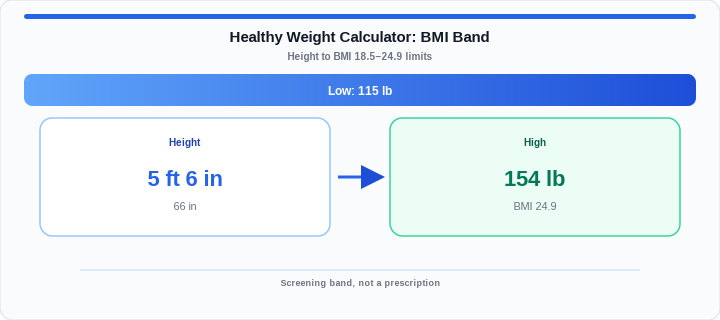
Your healthy weight range is defined as the weight interval that maintains a standard normal Body Mass Index (BMI) of 18.5 to 24.9.
The Mathematics of Healthy Weight Boundaries
Using height in meters (H), we rearrange the standard BMI formula (BMI = W / H^2) to solve for weight:
- Minimum Healthy Weight: W_{min} = 18.5 × H^2
- Maximum Healthy Weight: W_{max} = 24.9 × H^2
- To convert resulting kilograms to pounds, divide by 0.45359237.
Frequently Asked Questions
What does this healthy weight calculator measure?
It applies the formulas and lookup tables described on this page to your inputs and prints the same fields you see in the results table—use it as a quick check before you copy figures into email or client paperwork.
Are the results medical or legal advice?
No. Outputs are estimates for planning and education. Confirm high-stakes decisions with qualified professionals and your local standards.
Why might my hand calculation differ slightly?
Rounding order, unit conversions, and intermediate precision change the last digit. Match the tool’s units and rounding rules when you compare on paper.
Does this page store my data?
Calculations run in your browser for this session unless a specific tool notes otherwise. Nothing is uploaded to RapidRatio servers when you press Calculate.